Voice · After-hours
AI on-call intake for specialist referrals.
The Secure OnCall Intake Assistant answers referral and after-hours lines, captures the caller's clinical story, and prepares a structured intake record, so the on-call clinician can review the referral before calling back.
How the intake works
A referring healthcare professional reaches the assistant through your organization's agreed telephone pathway. The assistant collects the caller's identity and callback details, patient identifiers, the reason for referral, and the relevant clinical information.
Callers describe the case naturally. The assistant captures what has already been said and asks focused questions only for what is missing, so an experienced referrer is never marched through a rigid script.
Hear the assistant answer the line
This is the voice that greets a referring physician. Click to play with sound.
Demonstration audio from the product voice.
The intake happens while the page is still out.
The slow part of an urgent referral is not the conversation. It is the waiting, and the retelling. When intake runs in parallel with the page, the specialist reads the story instead of waiting to hear it.
Today — serial· ≈19 min to an informed specialist
With mAia — parallel· ≈10 min, summary ready before the callback
About half of the physician's time per referral, returned.
Modelled on a typical urgent specialist referral, on one shared time scale.
A clear record for clinician review
The intake record is ready for the on-call clinician before the callback, bringing the referral together in one place:
- The clinical history as the referring professional reported it
- Relevant findings, investigations, and imaging mentioned on the call
- The referring professional's specific request
- Caller identity and callback details
- Uncertain or missing information, identified for review rather than filled in by assumption
From call to consult note
Every intake produces two documents: the full transcript of the call, and an AI scribe consultation note prepared in the service's format. Both are delivered to each physician involved in the referral and filed to the hospital's EMR.
The referral then exists as a complete, reviewable record: what was said, what was asked, and what the on-call clinician received, in one place, from the first minute of the consult.
A record the hospital is accountable for
Hospitals are the health information custodians for urgent referral consultations, including provincially coordinated referral calls, and they carry the responsibility for keeping a record of them. Today, many of these conversations are documented partially, later, or not at all.
A structured intake record, with a transcript and a filed consult note, closes that gap for the hospital and for every physician on the call. What this returns to the service:
- Efficiency: about half of the physician's time per referral returned, because intake happens while the page is out
- Safety: the referring professional's account is captured once, at the source, instead of retold across a switchboard, a page, and a callback
- Quality: the specialist knows what the referring physician knows before the call starts, so the callback begins with the patient
- Accountability: a transcript and consult note on file, for the hospital and for every physician involved
Intake with a defined role
The assistant captures and organizes information. It does not independently triage referrals, give medical advice, assign urgency, or replace your paging and emergency response processes. The referring professional remains the source of the account, and the on-call clinician makes the clinical decisions.
Before deployment, your team defines the required fields, the telephone pathway, access permissions, the clinician review process, and the procedure for an interrupted or incomplete intake.
Inside the record
Screens from the working application, in a demonstration environment. All patients, clinicians, and sites shown are synthetic.
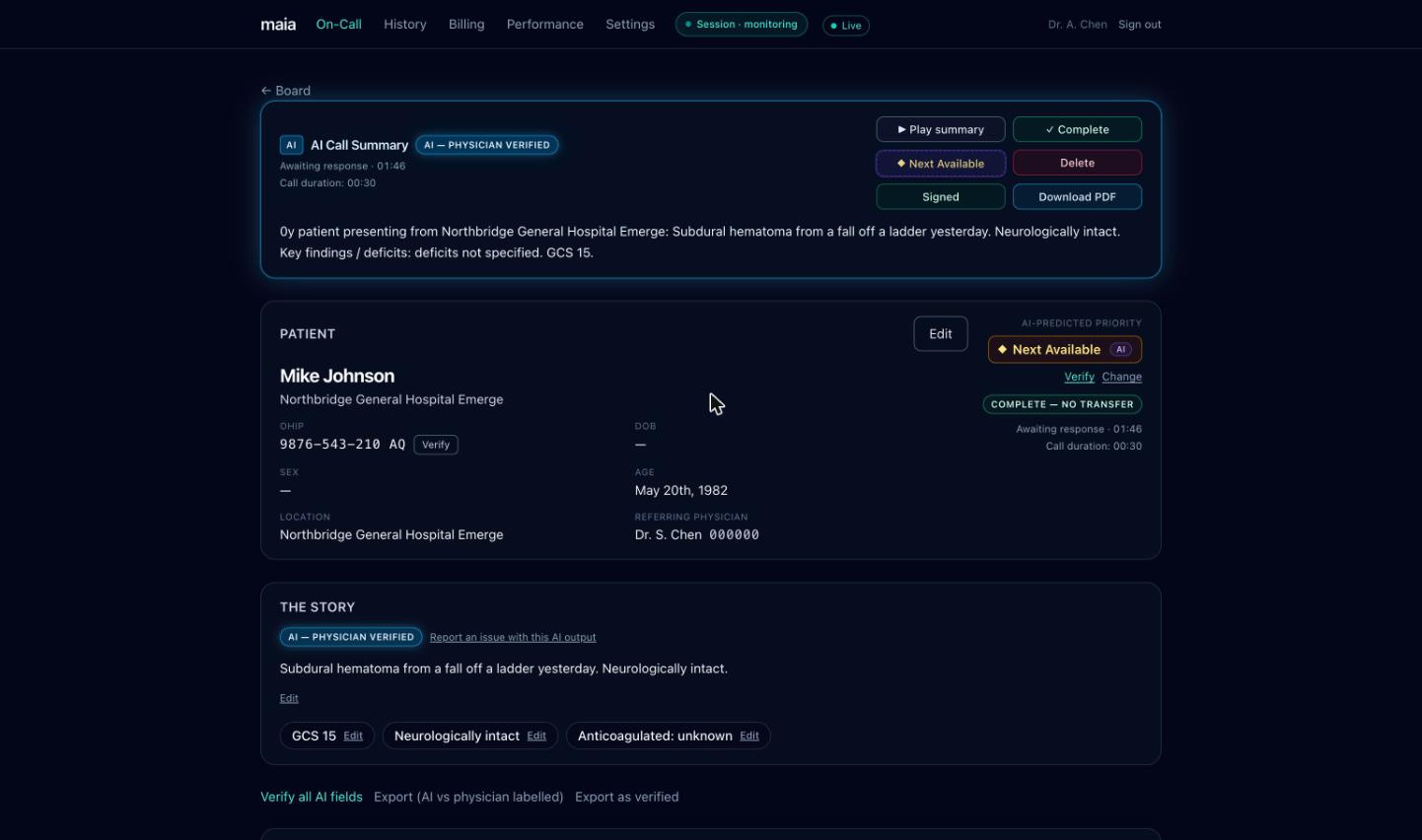
Every call becomes a structured case: the AI call summary, patient identifiers, the clinical story, and the AI-predicted priority, each marked as AI output until the physician verifies it.
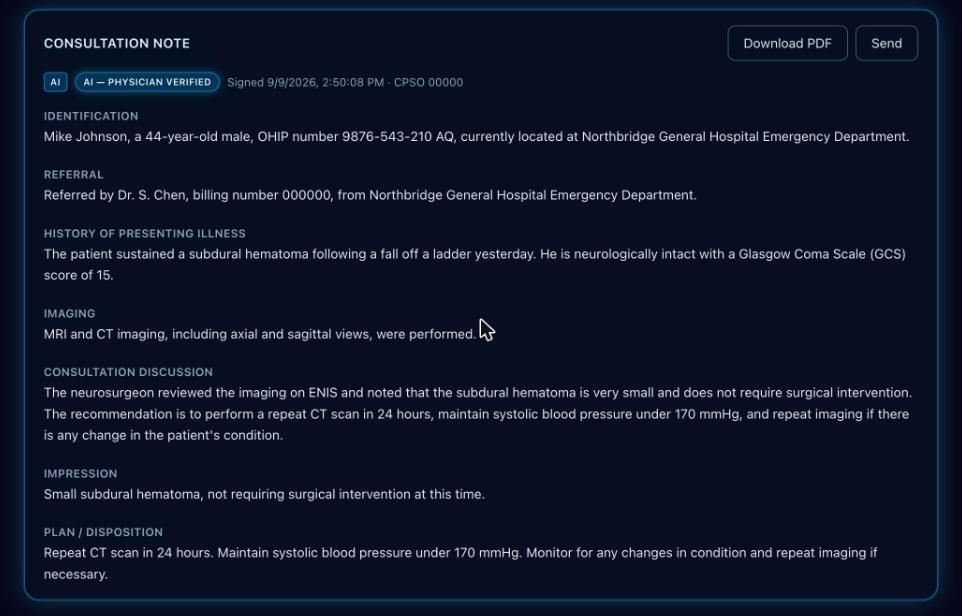
The AI scribe consultation note, physician verified and signed, ready to download as a PDF or send to the referring physician and the hospital EMR.
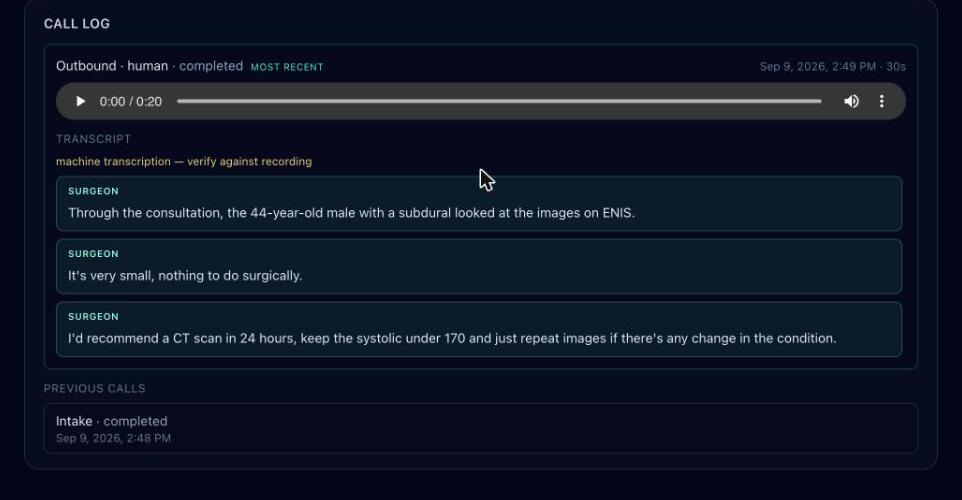
The callback is recorded and transcribed, so the consultation itself becomes part of the record rather than a remembered conversation.
Frequently asked questions
Who is the intake assistant for?
Healthcare professionals referring a patient to a specialist service. It is not a patient-facing emergency advice service.
Does it decide how urgently a patient needs care?
No. It documents the referral for clinician review. Clinical decisions remain with the responsible healthcare professionals.
Does it replace the existing pager or switchboard?
No. It works alongside your agreed paging and switchboard arrangements, and the exact routing is established for each deployment.
Show us how referrals reach your service.
Tell us what your clinicians need in hand before returning a call, and we'll configure the intake around it.
Book a Demo